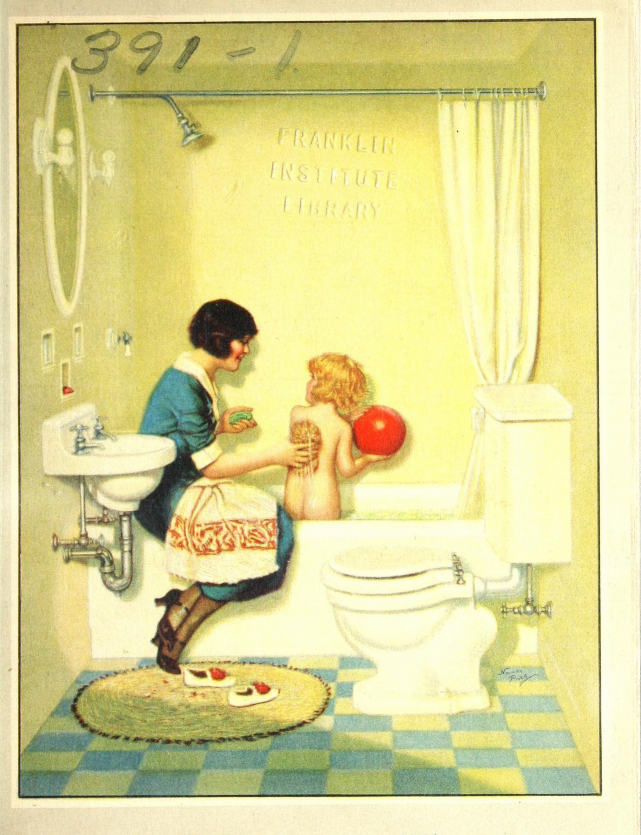
“In a room five feet square.”

While working on remodeling my bungalow bathroom (more on that later) I was looking for some vintage art to put on the wall. I found this 1922 ad:

1922.

I loved it immediately and decided that would be on my wall. (I ordered it from this eBay seller.) But, note the caption:

“Five Foot ‘Standard’ Bathroom
Pembroke Bath with Shower, Marcosa Lavatory
and Expulso Closet in a room five feet square.”

Five feet square?! 25 square feet? That’s a pretty small room, but it is possible if the sink is small. I grew up in a house that had a very small bathroom, but it was closer to 5′x7′ — the sink and toilet could both fit on the same wall, which at least left room for a laundry hamper.

Looking at other Standard ads from the 1920s, I saw this theme repeated over and over, usually with gorgeous painted artwork to illustrate (click each image to see a full version):

The advertising emphasized the flexibility and freedom of having these small bathrooms as convenient extra bathrooms in one’s home to “assure ideally ample bathroom facilities” and allow “leisurely washing, and splashing, and fixing, and primping before the lavatory glass.”

This ad attempted to appeal to both women and the men in their homes who might be irritated at the time spent in the bath:

"Oh how she had longed for a bathroom all her own" -- the freedom of not sharing a bathroom, by installing one in a five foot square space.  "Ample bathroom facilities are not a luxury." Though the room is small, it has rose tiles and a checked linoleum floor, with elaborate light fixtures.

“Oh how she had longed for a bathroom all her own” — the freedom of not sharing a bathroom, by installing one in a five foot square space.
“Ample bathroom facilities are not a luxury.” Though the room is small, it has rose tiles and a checked linoleum floor, with elaborate light fixtures.

Oh how she had longed for a bathroom all her own — where she could take her own sweet time, knowing it would not be remarked upon — confident that others were not being inconvenienced.

How hard it is to use a bathroom on schedule!

The bathroom in this ad, though tiny, had a sense of feminine luxury, with rose-colored tilework, golden sconces with aqua shades, and a butterfly area rug.

Unspoken in the Five Foot Square ad campaign was something else — if you can install a full bathroom in such a small space, you can easily add bathrooms to homes that previously didn’t have indoor plumbing.

Standard ads, both in the 1920s and otherwise, tended to promote elaborate and expensive luxury bathroom designs, ones which were out of reach for many. Earlier ads often showed fairly large bathrooms with features such as bidets and sitz baths, and it was common for the ads to show household maids at work in the bathroom. Here are a couple of the earlier Standard ads:

The Five Feet Square ads combined an appeal to luxury (extra baths for the lady who has everything) with an appeal to those homeowners still in smaller, older houses: you too, they said, can have glamorous indoor plumbing. All you need is a spare closet or the end of a hallway!

Whether the campaign was successful or not, I don’t know. By the 1930s, Standard seems to have moved on to ads emphasizing color, Art Deco modernity, and the replacement of old, “unsightly” fixtures such as clawfoot tubs. If you want a bathroom in a room five feet square, though, American Standard (formerly Standard) still sells a tiny sink or two.

Pinterest is not entirely clothes, food, and crafts

Part of Pamela Saunders' Black Death pinboard on Pinterest.

Part of Pamela Saunders’ Black Death pinboard on Pinterest.

During my long blog hiatus, Pinterest came along to provide the ability to “pin” cool images from the Web to save for later perusal. It combines an appeal to the visual with an appeal to the inner collector and hoarder that sits within far too many of us, which makes it more than a little addictive. I have spent way too much time on Pinterest lately, adding and organizing pins, creating new pinboards, and searching for new topics to curate.

At least among my contacts, Pinterest seems to feature a lot of DIY projects, clothes, and recipes. But it’s used to collect other things as well. The other day I stumbled on an interesting pinboard curated by Pamela Saunders on the topic of the Black Death, the medieval pandemic that may have killed one-third of the population of Europe in the late 1340s, and then returned at regular intervals for the next several hundred years.

A mass grave containing probable Black Death victims’ skeletons was found earlier this month in London during excavations for the Crossrail project, which brought this medieval pandemic into the daily news. Pamela’s pinboard links to that story, as well as to artwork inspired by the plague, mourning jewelry, fourteenth-century plague graffiti, and more. It’s an interesting assortment of links if you have any interest in this aspect of medieval history.

CITRON DATES ORANGE

Long time no blog. I’m finally biting the bullet and using one of the standard WordPress themes for this site — I just don’t have time to customize a whole theme anymore. I’m planning to post some more about a few of the things I’ve been doing lately, including interesting history trivia, crafts, design, and more.

Here’s something interesting I found tonight in the R. Williamson and Co. Catalogue No. 15, Illustrating Electric and Combination Fixtures/Art Glass Domes (undated, but by internal evidence it is no earlier than late 1908. Catalogue 14 was from 1906 and Catalogue 17 was from 1911, so I think that this one is from 1908-1909).

In the days of the telegraph, the cost of the telegram was based on the number of letters in the text. For this reason, it was common for people to use a “code” to send their message so they could send as few letters as possible while still getting their message across.

R. Williamson and Co. had a code in their catalogue, spread over two pages to include many necessary phrases. For example: PAPA 2378 FIR CELERY LENTILS RICE SISTER HOME was a much shorter and cheaper way to say “Can you ship fixture 2378 at once on receipt of order? Three light bracket, wired as explained in catalogue, assembled ready to hang, regular length as in catalogue, in the rich gilt and satin finish. Send by American Express, C.O.D.”

Here’s the full code.

telegraph code 1

telegraph code 2

Four years old?!

While I was searching for something else, I stumbled on this fairly horrifying story, published in the Schenectady Gazette, April 14, 1923. If you click on it you can see a larger copy. It says:

CHILD FOUND GUILTY OF MURDER

Montrose, Pa., April 13.—Four-year old Elmer Washburn, confessed slayer of Silas Payne, an aged recluse, was found guilty of murder in the second degree by a jury today. He will be sentenced later.

Young Washburn, it was testified at the trial, had seen Payne counting $2,000 in gold on numerous occasions at his shack near Montrose. The lure of the gold, the lad said, was too strong for him and he confessed that he had sneaked up behind the recluse and clubbed him to death. The gold was later recovered where Washburn told the authorities he had hid it.

Can that story be true? I didn’t have a chance to do any serious research on it. But I can’t imagine a four-year old child being able to club someone to death. Could it have been an error for “fourteen”?

Follow-up: Yes, it was an error. He was fourteen. I found it in the New York Times, November 2, 1922. Still a horrible story, but, sadly, much more believable.

The newest fashions (in 1903)

From The Delineator, summer 1903:

The Delineator was published by Butterick, the sewing pattern company, and included fashion articles and pictures, along with short stories and other articles. In one 1903 issue, there is a mention of the recent passing of Ebenezer Butterick, who founded the Butterick company in 1863 — and invented the graded paper sewing pattern.

The Butterick company still exists, but it is now part of McCall Pattern Company (which I think has itself been acquired by some other firm). Butterick patterns, for some weird reason, always seem to have annoying and confusing directions, compared to other pattern companies. I don’t know why. I’m glad they still exist, though.

Medical journal advertisements in 1886

(edited March 2013: Google broke my links to some of the images. Sorry if they don’t make sense anymore. Maybe I will fix them at some point. Damn Google.)

While searching for something entirely different on Google Books (which is just about my favorite place on the Web these days), I stumbled on an issue of The Lancet, a British medical journal, from 1886. The advertisements in it, for patent medicines, food, “sanitary appliances” and more, are fascinating. Here are a few:
Text not available
Yes, “liquid meat” would make me want to “barff”, too.

Text not available
Note “Coca.” As in “cocaine.” A “powerful nerve stimulant indeed!

Text not available
Ah, stout. “Particularly suited for invalids, ladies nursing, or anyone requiring a good strengthening beverage.” It’s what the doctor ordered!

A wealth of stained glass on Flickr

While looking for an image for someone tonight, I stumbled on one of the most beautiful photosets I’ve ever seen on Flickr: Gordon Plumb’s Stained Glass. 183 beautiful photos of stained glass, including some lovely photos of William Morris-designed windows.

After viewing Plumb’s set I wanted to look at some more glass, and found the English Stained Glass — Pre Victorian pool. More great photos. Something I found interesting in this one was the large amount of windows that are made up of fragments of older windows, put together in a sort of collage. It makes me quite sad that so many windows were destroyed, though the new versions are nice, too.

And finally, there is the general Stained Glass pool, with more than 11,000 pictures to enjoy.


Pattern: Diane Sweater from 1921

1921 Fleisher Yarn ad

Recently I was looking through the book For The Love of Knitting, which includes many pictures of vintage knitting patterns and books, and I noticed that one of the illustrations was of a Fleisher yarn company ad from 1921. The ad included a complete pattern for a very cute drop-stitch sweater, which it claims takes “less than two days’ time”! Now, here’s the neat thing — anything published pre-1923 is in the public domain in the United States. So this ad and the knitting pattern it contains are in the public domain (probably why the book included it). So I’m reprinting the 1921 pattern here for anyone who is interested.

More photos and the pattern text after the jump!


Continue reading

The Gentleman’s Page

The Gentleman’s Page is subtitled “A Practical Guide for the 19th Century American Man.” And it is, indeed. Browsing this site, you’ll learn how the men of that period dressed (frock suits, sack suits, and so on), how they acted (the correct bowing technique), and even the strict etiquette on how they should use their visiting cards when calling on acquaintances. Photographs and illustrations from the period are included. It’s quite fascinating.

Tasty art

While browsing Shorpy, I saw a link to Box of Apples — a site devoted to fruit crate label art. They sell giclée prints of them, but even if you’re not in the market, the gallery is a fun browse. They mention in their blog that “…one reason these labels are so pretty is that instead of the usual four-color printing (where cyan, magenta, yellow and black are combined to produce the desired hue), they used eight- and twelve- color printing.” Close-up examples are provided to illustrate this. They are all great, but I think I like this one the best.

The past in photos

Shorpy: The 100-Year-Old Photo Blog is one of those blogs that just makes you say “Wow!” on a regular basis. The photos aren’t all a century old, though some of them are. (Lately a lot of them have been Depression-era.) But they are all quite old, and quite amazing to look at. Many are just plain beautiful. Others are more thought-provoking.

I especially like the 4×5 Kodachrome transparencies like this and this — it’s so strange to see these times so long ago in color that seems so real. We are used to seeing most photos of that era in black and white, or sepia-tone, or hand-colored, or faded old colors. But of course, real life was colorful.

Kurt Cobain vigil photos, April 1994

While I was going through photo albums looking for photos to upload to Flickr, I found a group of photos that I took on April 10, 1994, at the Seattle Center memorial vigil for Kurt Cobain. These are the photos.

I looked online for articles about that day, and surprisingly, found very little. Here’s something I wrote about it myself on Metafilter, a few years ago.

It’s hard to believe that 13 years have already gone by.


Graffiti, Olympia, Washington, 1985

I’m going through old scrapbooks and albums to find photos to put onto Flickr. Lots of my photos are in terrible shape and I don’t want to lose them completely. This one is scanned from a contact sheet that is not in good condition — I don’t have a good full-size print of it any more and I’m not sure if I still have the negative, though it might be in a notebook in one of my boxes o’ junk.

Anyway, I was prowling downtown Olympia on a dark cloudy day in 1985, looking for something I could photograph for Bob Haft’s Experimental Photography class at Evergreen. The due date was the next day and I had procrastinated as usual. I turned a corner into an alley and found this graffiti. When I developed the photo, it didn’t look like Olympia; it seemed like something from a war zone in the 1940s.

I made a hand-colored print (which has since been destroyed), and turned that in for my assignment. This is one of my favorite photographs (though it’s not very cheery, is it?), so I hope I can find the negative and get some real prints made again sometime. Because this is scanned from the contact sheet, it looks even more vintage and unreal than the print did; it’s got a touch of blurriness and noise.

I’ve got some other old photos up at Flickr now and I might post more of them here on the blog soon.

Mystery book

Today I received a book in the mail, the book pictured on the right: Vanishing Seattle by Clark Humphrey. This is a book I’ve had on my wish list for a while; it’s got a ton of great pictures of Seattle landmarks that have sadly disappeared. I’m old enough now to remember a lot of them. Some of them I didn’t realize had gone. So, anyway, I’m thrilled to have this book. But the thing is — I didn’t order it. I was going to order it but hadn’t gotten around to it yet. So it’s a mystery: who sent me the book? Thank you, whomever you are.

And by the way — if you are a Seattleite who has been here for a while, you want this book. Trust me.